
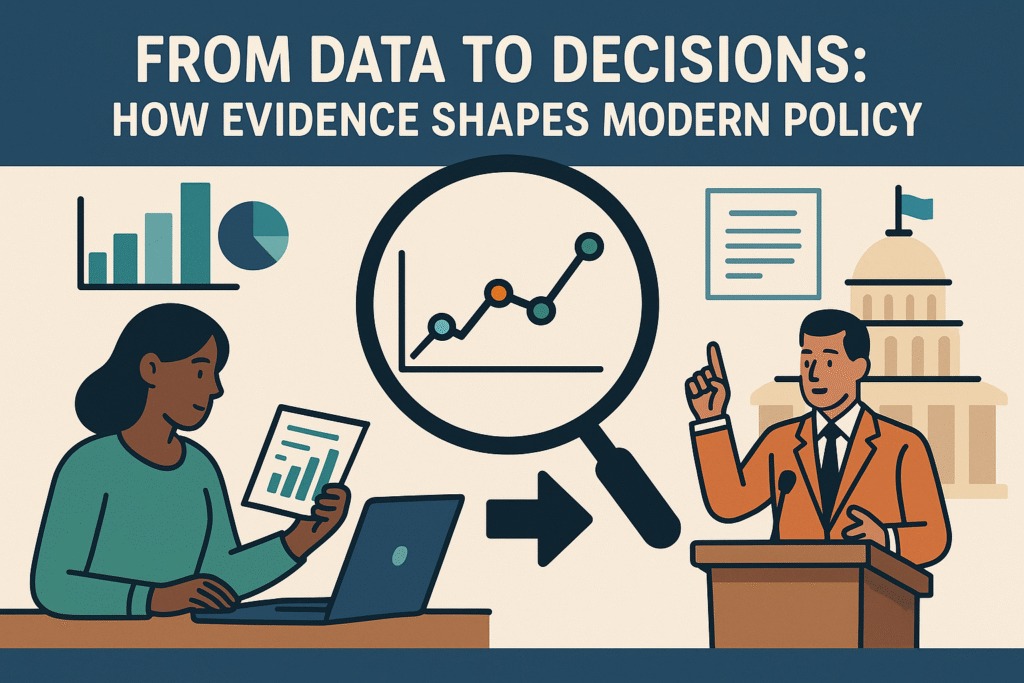
From Data to Decisions: How Evidence Shapes Modern Policy
In an era marked by complex global challenges—climate change, pandemics, inequality—the demand for policies grounded in evidence rather than ideology has never been greater. The idea of “evidence-informed policymaking” (EIPM) rests on a simple but powerful premise: decisions should be guided by the best available research, data, and analysis, rather than political convenience or tradition. Yet, as scholars like Brian W. Head remind us, turning this aspiration into reality is anything but simple.
The Promise of Evidence
Evidence can shape policy in several powerful ways. First, it helps governments understand what works and what does not. Systematic evaluations—such as those reviewed by the OECD and WHO—allow policymakers to identify effective interventions, replicate successful programs, and scale up proven solutions. Evidence also adds legitimacy to decision-making, building public trust in institutions that are transparent about how and why they act.
In the health sector, for example, frameworks developed by the WHO and public-health researchers emphasize using data on effectiveness, feasibility, and equity when deciding on interventions. Similarly, evidence gap maps and systematic reviews now help decision-makers visualize where knowledge is strong and where further research is urgently needed.
The Politics of Knowledge
However, evidence does not exist in a vacuum. Policy choices are shaped as much by values and power as by data. Evidence competes with ideology, interest groups, and institutional inertia. A 2025 review in Frontiers in Communication highlighted barriers such as political cycles, lack of communication between researchers and policymakers, and limited capacity within government agencies to interpret complex data.
This is why recent studies—like those by the Urban Institute and the UK’s Government Research Transparency Department—stress the importance of translation and communication. Evidence must be accessible, contextualized, and relevant to policymakers’ priorities. Reports written in technical language, detached from local realities, rarely move political action.
From Evidence to Impact
Effective evidence-based policy is not just about producing research; it is about creating systems that link knowledge with action. The OECD’s 2024 report on capacity building outlines how institutional reforms, training, and cross-sector collaboration can foster a culture of learning and adaptation. Similarly, implementation science reminds us that even the best evidence can fail without attention to how policies are delivered and sustained.
Successful evidence-informed policymaking is, therefore, both an art and a science—a process of negotiation between researchers, practitioners, and the public. When done well, it creates feedback loops that continuously refine interventions, improve outcomes, and ensure accountability.
Conclusion
Evidence alone cannot dictate policy, but it can illuminate choices and anchor decisions in reality. By embedding evidence into every stage of the policy cycle—from design and implementation to evaluation—societies can craft smarter, fairer, and more resilient systems. In a world overflowing with data but starved for wisdom, using evidence wisely is not just good governance—it is essential for progress.
Sources
- Head, B. W. (2010). Reconsidering evidence-based policy: Key issues and challenges. Policy and Society.
- OECD (2024). Building Capacity for Evidence-Informed Policy-Making.
- WHO (2021). Guide for Evidence-Informed Decision-Making.
- Urban Institute (2024). Improving Evidence-Based Policymaking: A Focused Review.
- Frontiers in Communication (2025). Scientific evidence and public policy: A systematic review of barriers and enablers.
- Implementation Science (2021). Understanding the implementation of evidence-informed policies and practices.
- On Think Tanks (2024). Rethinking evidence-informed policy and scaling